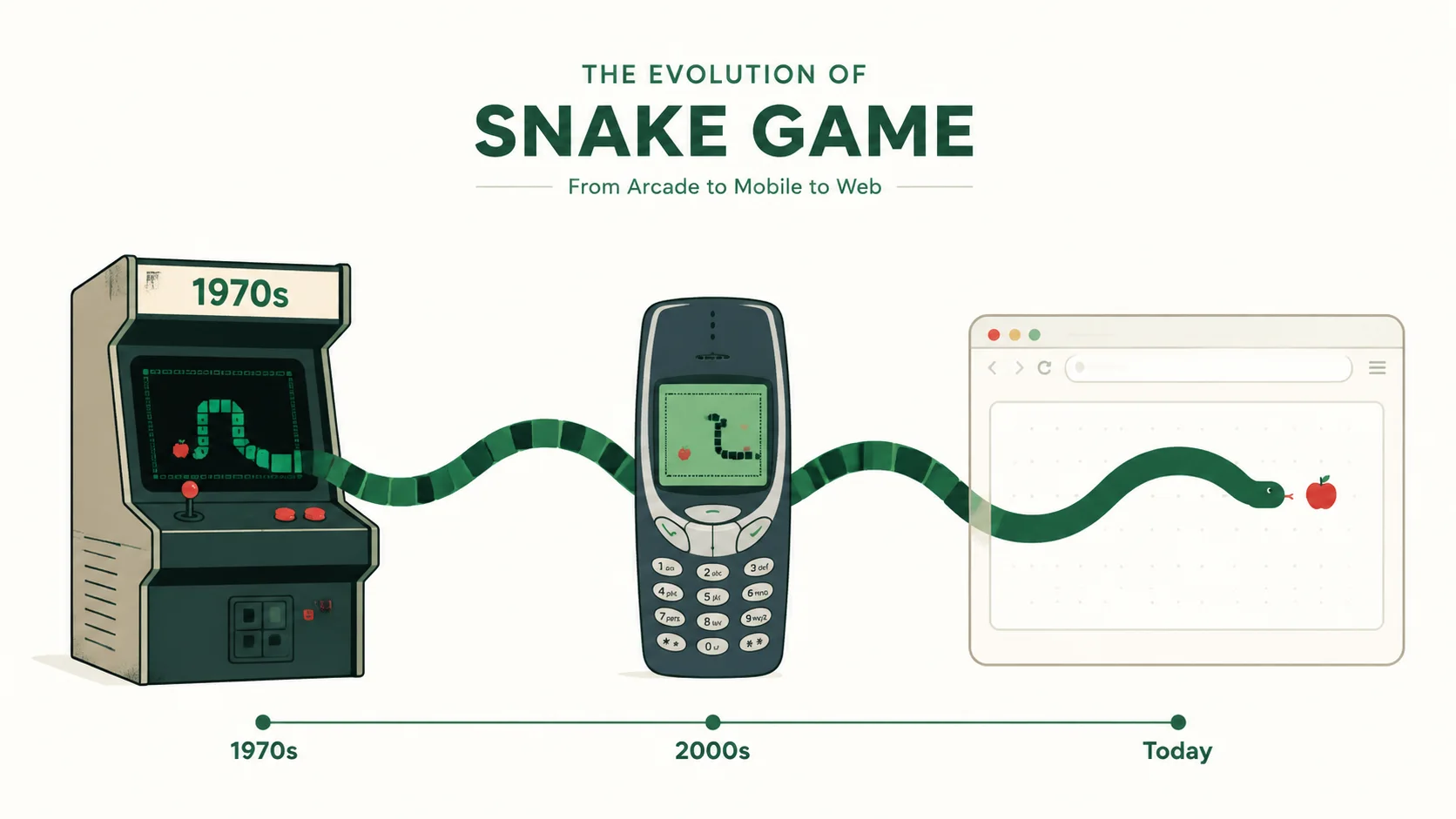
Snake feels as if it has always existed. Its rules can be explained in seconds: steer a growing line, collect food, and avoid a fatal collision. Yet the familiar formula did not arrive fully formed under one title. It emerged through arcade competition, home-computer experiments, mobile hardware, and web technology. Each platform stripped the idea down and rebuilt it for a new audience.
Snake history at a glance
| Year | Game or event | Why it matters |
|---|---|---|
| 1976 | Blockade | Gremlin Industries established the competitive, trail-laying arcade form. |
| 1977 | Surround | Atari brought a related two-player enclosure game to the Video Computer System. |
| 1978* | Worm | An early computer variation, though its exact dating and lineage are not uniformly documented. |
| 1982 | Snake Byte and Nibbler | Food collection and a lengthening body moved toward the recognizable solo formula. |
| 1991 | QBasic Nibbles | A bundled PC program introduced the concept to learners and home-computer users. |
| 1997 | Nokia Snake | Taneli Armanto adapted the game for the Nokia 6110 and mobile keypads. |
| 2009 | thoughtbot HTML5 version | A canvas tutorial demonstrated a clean, plugin-free browser implementation. |
| 2010 | YouTube Easter egg | Snake appeared as a hidden interaction inside online video playback. |
| 2013 | Google Doodle | A Chinese New Year Doodle recast the mechanics as a festive browser game. |
| 2019 | Google Maps Snake | The formula became a transit-themed trip through cities and landmarks. |
*Worm is commonly dated to 1978, but surviving accounts vary. It is best treated as an early milestone rather than a precise single point of origin.
Before Snake had its famous name
Gremlin Industries released Blockade in 1976. Two players directed continuously moving marks around a black-and-white arena. Every move left a solid trail; hitting a wall or either trail ended the round. The objective was not eating or growing but forcing the other player into shrinking space. That distinction matters. Blockade is reasonably described as a progenitor of Snake, not as the first title literally named Snake.
The design quickly proved portable. Atari released Surround in 1977 for its Video Computer System, later known as the Atari 2600. Its right-angle movement, persistent barriers, and head-to-head pressure translated the arcade idea to a home console. The Museum of Modern Art now includes Snake in its collection, an acknowledgment that the broader design became culturally significant beyond any one machine.
An early computer game called Worm is commonly dated to 1978. However, historical summaries do not always agree on its platform, publication details, or exact relationship to later versions. The cautious conclusion is that worm-and-trail games were already circulating around computers by the late 1970s, while the genre's authorship remained distributed across implementations.
From blocking rivals to eating and growing
The early 1980s made the form more recognizable. Snake Byte, published in 1982, asked players to guide a snake toward food while its body lengthened. That growth converted success into danger: every collected item made the next turn harder. The game was no longer only about fencing in an opponent. It became a contest against one's own increasingly complicated path.
Rock-Ola's 1982 arcade game Nibbler pushed a related idea through mazes. Its creature consumed objects, became longer, and had to escape without colliding with itself. Maze structure gave each level a deliberate route-planning puzzle, while arcade scoring made improvement visible. Together, these games helped establish the feedback loop now associated with Snake: collect, grow, lose maneuvering room, and survive long enough to collect again.
In 1991, Microsoft included Nibbles as a QBasic sample program. For many PC users, it was both entertainment and readable source code. Learners could inspect how movement, collision, scoring, and screen updates worked, then change the program themselves. Snake's simple state made it ideal for teaching: a direction, a list of body positions, a target, and a few collision rules can produce a complete game.
Nokia puts Snake in millions of pockets
The decisive popular breakthrough came from Nokia. Finnish software engineer Taneli Armanto created Snake for the Nokia 6110 in 1997. The handset reached retail markets around 1997-98, and the built-in game required no cartridge, download, or separate purchase. It was simply present when owners explored the phone.
Armanto's version was an excellent fit for the hardware. A monochrome grid made the snake legible; keypad buttons supplied direct turns; short sessions suited waiting rooms and bus stops. Limited processing power was not a weakness because the underlying design needed so little. As Nokia phones spread internationally, Snake reached people who did not identify as console or computer players.
Nokia did not invent the trail-game lineage, but it gave the genre its dominant cultural image. The compact handset and pixelated line became inseparable. Later Nokia editions added refinements, but the historical achievement of the 6110 version was accessibility at enormous scale. In 2005, Armanto received special recognition from the Mobile Entertainment Forum for his role in mobile entertainment.
The browser becomes Snake's natural home
Snake migrated readily to the web because its visuals and logic required few assets. Early browser versions used Java applets, Flash, or JavaScript-driven HTML elements. As browsers matured, the HTML5 canvas element offered a cleaner surface: code could draw the board, erase a frame, and redraw the snake without a plugin.
In 2009, software studio thoughtbot published an HTML5 canvas Snake game and explained its construction. The project arrived during a wider shift toward standards-based interactive graphics. It also demonstrated why Snake remains a favorite programming exercise. The game is small enough to understand in one sitting but rich enough to teach timing loops, keyboard input, random placement, arrays, and collision detection.
By 2010, Snake could even hide inside another web experience. YouTube added a playable Easter egg to its video player: under the right conditions, keyboard input launched a snake over the paused or playing image. It was a novelty, not a permanent gaming platform, but it showed how universally recognizable the mechanic had become. A moving chain and a target needed almost no introduction.
Google remixes a universal rule set
Google used the formula for its Chinese New Year Doodle on February 10, 2013. The interactive celebration adapted Snake to the Year of the Snake, surrounding familiar collection and movement with holiday imagery. Because a Doodle sits on a search homepage, the game reached an audience far beyond dedicated game sites while remaining instantly playable in a browser.
Google returned to the concept in 2019 with a Maps-themed release. Instead of an abstract snake, players guided trains or buses around destinations, picked up passengers, and collected landmarks. Cities supplied visual identity, but the old pressure remained: every successful pickup extended the vehicle and made open space more valuable.
These versions reveal the durability of the design. Snake can become a train, a parade, a worm, or a line of pixels without losing its identity. The theme is replaceable because the rules carry the experience. Growth is both reward and penalty, so difficulty rises directly from success rather than from a long tutorial or complicated opponent.
Why Snake keeps returning
Few games scale so gracefully across technology. Snake works with four keys, a keypad, a swipe, or a controller. It can run on a tiny monochrome display or fill a modern browser window. A new player understands the immediate goal by watching for seconds, yet a skilled player can study routes, preserve open lanes, and manage the tail.
Its history is therefore not a straight line from one inventor to one finished product. It is a sequence of adaptations: Blockade formalized the lethal trail, early computer and arcade games added collection and growth, Nokia made the pattern mobile, and the web made it endlessly reproducible. Every era found that the same constraint still worked: the better you do, the less room you have left.