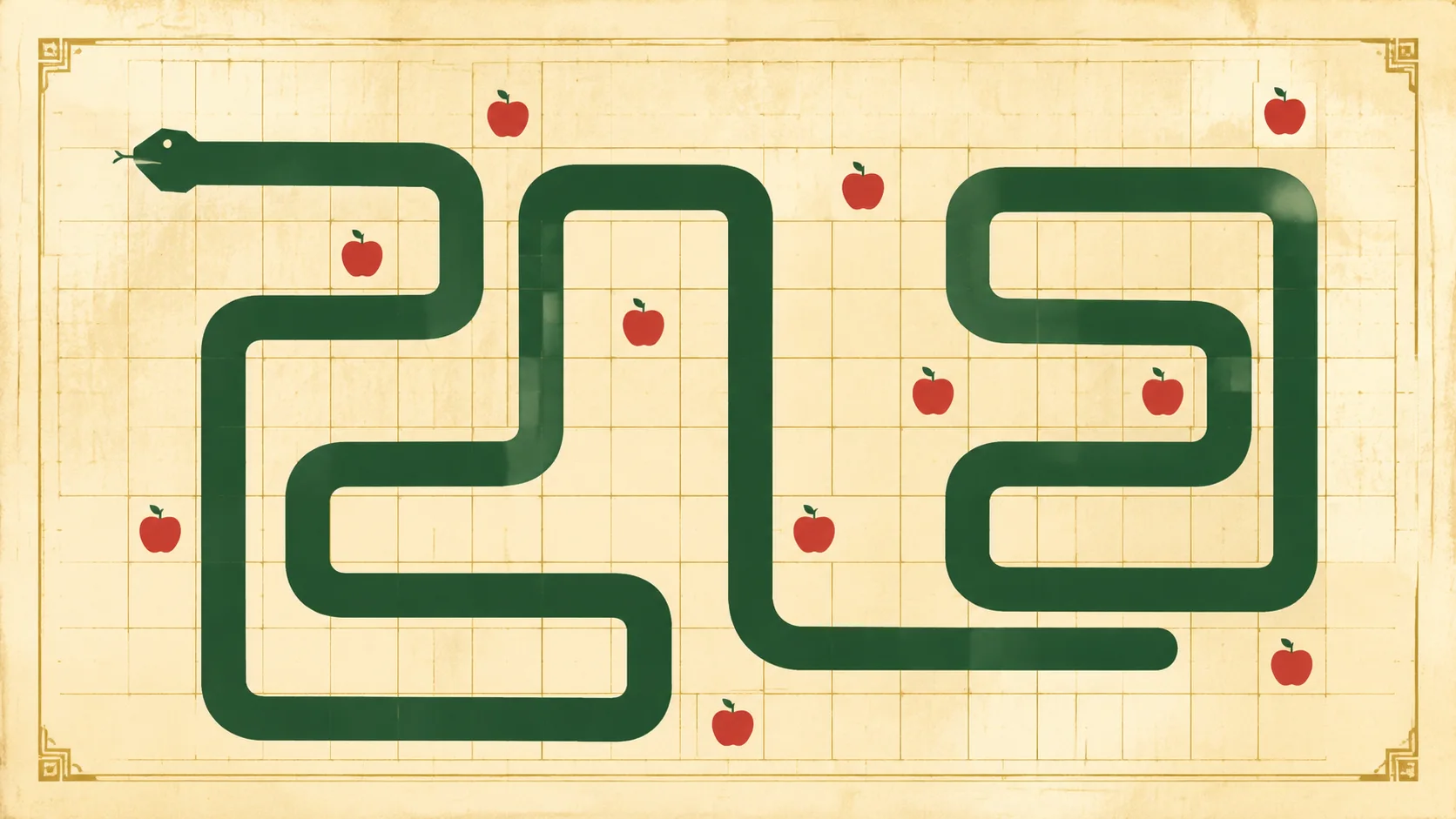
A good Snake run is a problem of space management. Every apple makes the body longer, so every success also removes room for future movement. The useful question is not simply, “Can I reach the apple?” It is, “After I eat it, can my head still reach open cells without crossing my body?” Once you judge moves by what they leave behind, scores become more consistent and late-game traps become easier to recognize.
Key takeaways
- Preserve one large connected area instead of dividing the board into narrow pockets.
- Use the perimeter for stable travel, but enter the center only with a clear exit.
- Build parallel rows into a repeatable serpentine route as the snake grows.
- Turn deliberately and evaluate where the tail will move, not only where it is now.
- Change priorities by phase: collect early, organize in the middle, and survive late.
Beginner fundamentals: make every turn legal
Start with the rules that end most short runs. Know whether your version has solid walls, wraparound edges, obstacles, or speed changes. Never reverse directly into the next body segment. Keep your eyes one or two cells ahead of the head rather than fixed on the apple, and read the body as a moving wall.
Favor wide turns. A one-cell corridor is safe only when you know where it exits and whether the tail will clear in time. When several paths reach the same apple, choose the one that leaves your head facing open ground. The shortest route is often strategically expensive because it can cut the board in half.
If you want a clean place to rehearse these basics, open the classic Snake game. Begin at a comfortable pace and make survival, not speed, the first objective. You can compare longer runs on the leaderboard after your route becomes repeatable.
Open space is your real resource
Imagine the empty cells as a single territory the head needs to keep accessing. A dangerous move creates a body wall from one edge toward another, leaving the head on the small side and the tail on the large side. The apple may be reachable, yet the run is already failing because the remaining route closes behind you.
Before a turn, scan for connectivity. Can the head move from its destination into more than one lane? Does the body form a barrier that will persist? Is there room to loop while the tail advances? Prefer moves that keep alternatives available. An open rectangle is valuable because it permits several turn shapes; a narrow chamber may offer only one.
Perimeter versus center
The perimeter is predictable: an edge protects one side from accidental self-crossing and supports long, orderly passes. It is a good place to establish direction or wait for the tail. But hugging the wall without a plan can leave no outside escape, especially when your body seals the only inward turn.
The center offers flexibility but invites crossings. Treat it as a transit zone, not a place to scribble. Enter along one lane and leave along another; avoid circling an apple so tightly that your body becomes a closed ring. A practical rhythm is to travel long distances near the perimeter, make controlled sweeps through the center, then return to an outer lane.
The parallel-row serpentine strategy
A serpentine route organizes the board into parallel rows. Move across one row, turn into the next, travel back in the opposite direction, and repeat. This reduces improvisation and keeps adjacent body segments aligned instead of scattered. The pattern is not a promise of a perfect run; it is a framework that makes available space easier to read.
Leave enough separation between the head’s current lane and a body lane that has not cleared. On a simple grid, the route can fold row by row while one edge remains available as a return corridor. Do not close that corridor prematurely. If the apple appears away from the planned lane, decide whether a detour can rejoin the pattern without trapping a pocket of empty cells.
The diagram is a planning model, not a claim that every Snake version uses this board size. Transfer the principle to the grid in front of you: parallel lanes, predictable turns, and a reserved connection between the head’s region and the tail’s region.
Tail timing and input discipline
The tail vacates a cell as the head advances, except when growth rules temporarily delay that clearance. That makes the tail a moving doorway. Following behind it can be safe because each step opens space, but cutting toward its current position can fail if an apple changes the timing or the route is one cell too short.
Track direction rather than trying to count every segment. Ask where the tail lane is flowing and whether your head can arrive after, not before, it clears. When uncertain, take a wider loop. Extra travel is useful when it converts a timing guess into a visibly open path.
Good routing still depends on clean controls. Press once per intended turn, especially near corners. Stacked or frantic inputs can produce an unplanned second turn before you see the first one resolve. Keep a steady hand position, anticipate the turn cell, and do not “correct” a legal move merely because it looks close. Input discipline lets the route in your head match the route on the board.
Change your plan as the snake grows
Short phase: learn the board
Early in a run, the short body allows direct collection. Use this freedom to identify boundaries, speed, and turning behavior. Avoid creating tiny enclosed regions, but do not force a full serpentine pattern before it helps. Broad loops reveal how the game responds while keeping recovery easy.
Medium phase: organize the route
As crossings become meaningful, shift from apple pursuit to lane building. Align body sections, use longer perimeter passes, and establish a return corridor. Take an apple when the approach and departure both fit the larger route. This is where most strategic discipline pays off.
Long phase: protect continuity
Late in a run, empty cells are scarce and improvisation is costly. Stay with a route that visits available cells in a stable order. Decline shortcuts that place the head inside a body loop. The apple is secondary; survival depends on preserving the sequence that lets the tail keep opening the next lane.
Common mistakes and better responses
| Mistake | Why it fails | Better response |
|---|---|---|
| Taking the shortest path to every apple | The body may divide open space or block the exit. | Choose a route with a visible departure lane. |
| Living on the perimeter | A body wall can remove the only inward turn. | Reserve regular entry points to the center. |
| Making tight spirals | The head can become sealed inside its own body. | Use broad folds with an open return corridor. |
| Turning reactively | Rapid inputs create accidental double turns. | Anticipate the cell and press once. |
| Assuming the tail will clear | Growth can alter the expected timing. | Take another loop until the cell is visibly free. |
A focused practice routine
- Play one run using only broad turns and score it by survival quality, not apples collected.
- Play one run while keeping the empty area connected; notice each move that nearly divides it.
- Practice alternating parallel rows while deliberately preserving one return corridor.
- In a later run, narrate “entry, apple, exit” before committing to each collection.
- After a loss, identify the first space-management error, not merely the final collision.
Repeated diagnosis builds more skill than repeatedly restarting at speed. Return to the SnakeAppleGa.me home page for another game, or add context with our guides to the history of the Snake game and Google Snake versus classic Snake. Different versions may change presentation and rules, but route planning remains a useful way to think.
Methodology
This guide derives its recommendations from standard grid-based Snake mechanics: continuous forward movement, growth after collecting an item, collision constraints, and cells reopening as the tail advances. The route examples were reasoned from those rules and checked as deterministic grid sequences. No external performance claims, player statistics, or invented testing results are used. Individual game variants may alter walls, speed, growth, or wraparound behavior, so confirm the rules of the version you play.